


Grade 3
Math: Composite Claim 2: Mathematical Practices

Students can use problem solving strategies and mathematical models to:
- represent, analyze, and solve complex, well‐formed or not yet fully formed problems that are presented in mathematical or real‐world contexts;
- make productive use of mathematical concepts, procedures, and tools;
- interpret results;
- communicate clearly and precisely about their own reasoning and the reasoning of others.


Sample Test Questions
Here are sample test questions that show the skills and concepts students should know and understand in Grade 3.
-
 1
-
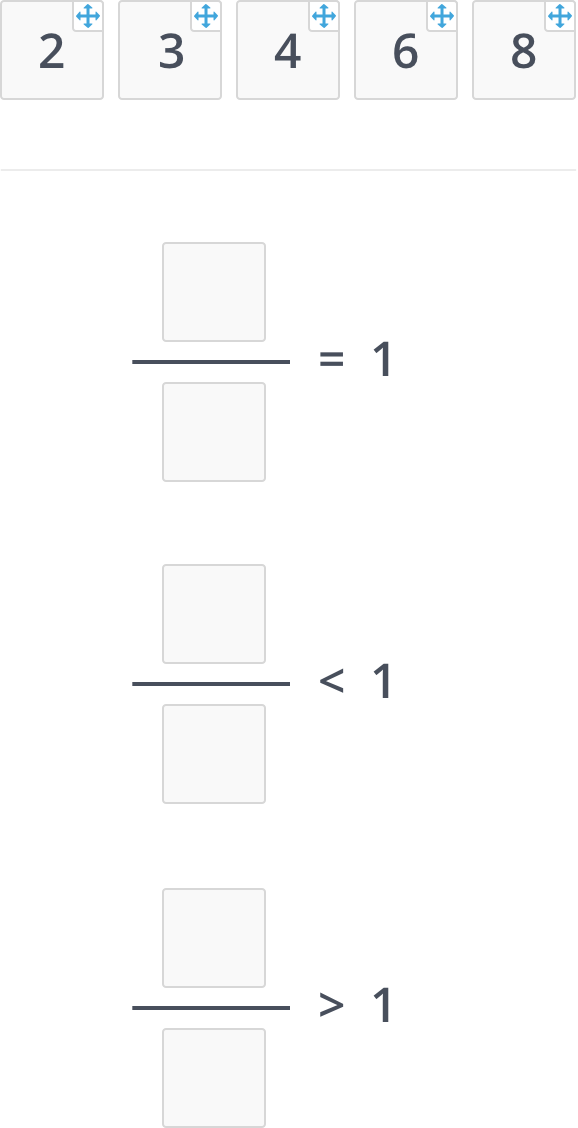
Drag one number inside each box to make each statement true.
-
-
For the first fraction equal to 1: 2/2, 3/3, 4/4, 6/6, or 8/8
For the second fraction less than 1: 2/3, 2/4, 2/6, 2/8, 3/4, 3/6, 3/8, 4/6, 4/8, or 6/8
For the third fraction greater than 1: 3/2, 4/2, 6/2, 8/2, 4/3, 6/3, 8/3, 6/4, 8/4, or 8/6
-
-
2
-
Nicki is comparing fractions.
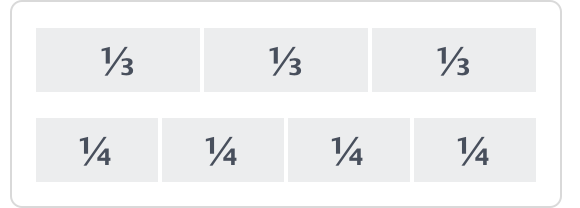
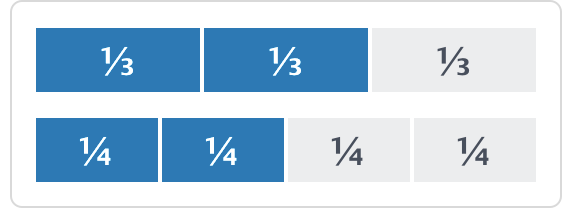
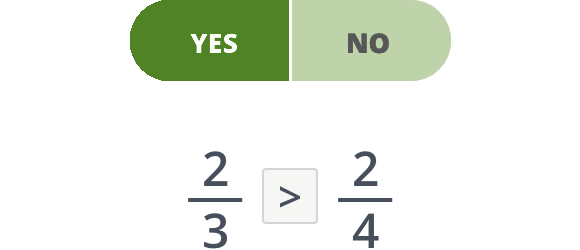
She states, “\frac{2}{3} is greater than \frac{2}{4} because each \frac{1}{3} piece is larger than each \frac{1}{4} piece.”
Part A
Click on the fraction bars to show \frac{2}{3} and \frac{2}{4}.
Part B
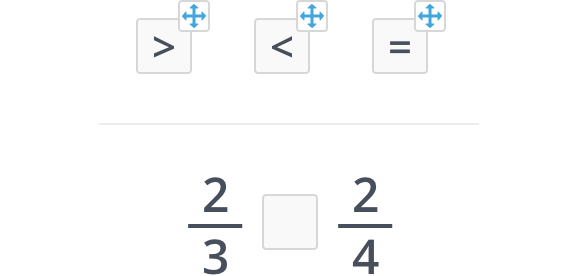
Is Nicki correct? Click Yes or No.
Drag the correct symbol to compare the fractions.
-
Part A
-
-
Part B
-

-
-
Part A
-
-
Part B
-
-
-
3
-
Libby said the answer to the problem 5 × 2 × 3 is 25. Her work is shown.
- Step 1: 5 × 2 = 10
- Step 2: 5 × 3 = 15
- Step 3: 10 + 15 = 25
Which is true?
-
-
A
Libby’s answer is correct because 10 + 15 = 25.
-
B
Libby’s answer is correct because 2 + 3 = 5 and 5 × 5 = 25
-
C
Libby’s answer is not correct because she multiplied 5 × 3 and 5 × 2.
-
D
Libby’s answer is not correct because she should have multiplied 10 × 15.
-
A
-
-
C
Libby’s answer is not correct because she multiplied 5 × 3 and 5 × 2.
-
C
-
-
4
-
There are 9 cherry trees.
- Kim picks 8 cherries from each tree.
- Kim eats 14 of the cherries she picked.
Enter the number of cherries Kim has left.
-
58
-
-
5
-
Kaden has 7 bags of animal toys. Each bag has these animal toys in it.
- 1 whale toy
- 5 dolphin toys
- 2 turtle toys
How many animal toys does Kaden have altogether?
Select all of the equations that show how to find the total number, t, of animal toys.
-
-
-
6
-
Jan divides 36 pens into groups.
- Each group has the same number of pens.
- Jan uses all of the pens.
For each number of pens in a group, click Yes or No to show if Jan can create groups that each have that number of pens.
-
Yes No
-
Yes No
-