

Grado 8
Matemáticas: Reivindicación compuesta 2: Prácticas Matemáticas
Los estudiantes pueden utilizar estrategias de resolución de problemas y modelos matemáticos para:
- representar, analizar y resolver problemas complejos, bien formados o aún no completamente formados que se presentan en contextos matemáticos o del mundo real;
- hacer uso productivo de conceptos, procedimientos y herramientas matemáticas;
- interpretar resultados;
- comunicar con claridad y precisión sobre su propio razonamiento y el razonamiento de los demás.

Preguntas de las pruebas de muestra
En esta sección encontrarás ejemplos de preguntas de examen que muestran las habilidades y los conceptos que deberían conocer y comprender los estudiantes.
-
 1
-
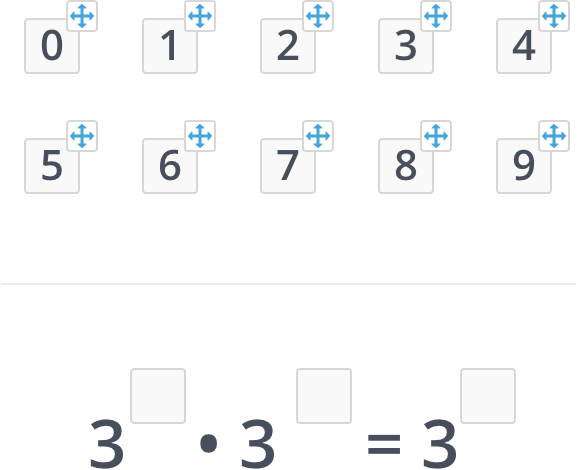
Steven claims that when you multiply two powers with the same base, the new exponent is the product of the original exponents. He uses the example below to support his claim.
32 ⋅ 32 = 3(2⋅2) = 34
Drag a number into each box to create an equation that shows Steven’s claim is incorrect.
-
-
-
2
-
Marco says that the interior angles of a triangle add up to 180°. He claims that the interior angles of a hexagon must add up to 360° because a hexagon has twice as many vertices as a triangle and can be divided into two triangles. Therefore, its interior angles must sum to twice the value of those of a triangle.
Which statement, if any, explains Marco’s error? -
-
A
A hexagon does not have 6 vertices.
-
B
A hexagon can be divided into 4 triangles, not 2.
-
C
The interior angles of a triangle do not add up to 180.
-
D
Marco’s statement is correct and contains no error.
-
A
-
-
B
A hexagon can be divided into 4 triangles, not 2.
-
B
-
-
3
-
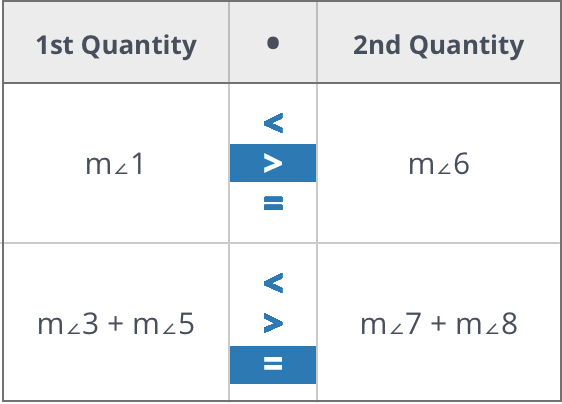
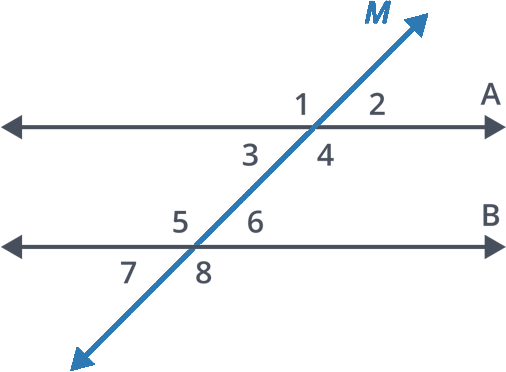
Parallel lines A and B are cut by a transversal line M, as shown in the diagram.
-
-
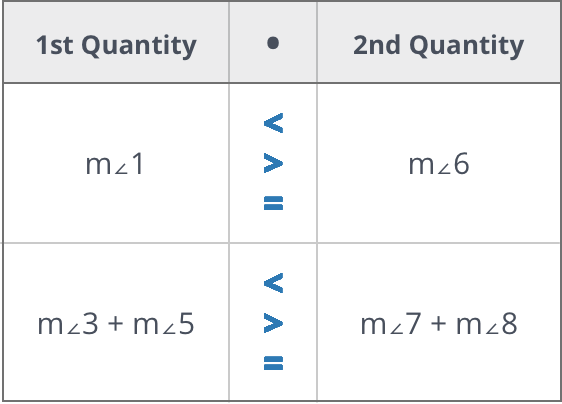
The measure of ∠2is less than the measure of ∠4.
For each comparison, select the symbol that makes the relationship between the first quantity and the second quantity true.
-
-
-
4
-
A biologist tracks the number of bacteria living in a water tank. The biologist used a function that represents the amount of a certain chemical solution that is added to the water.
When the water has no chemicals, the number of bacteria (b) is 1200 per gallon.
For each tablespoon of the chemical solution (c) added to each gallon of water, the number of bacteria decreases by 75 per gallon.
How much of the chemical, in tablespoons, must be added to a 500-gallon tank to reduce the bacteria count to a safe 300 bacteria per gallon?
-
6,000
-
-
5
-
Samantha gathered the following information on a given day at the dog park.
- There are 32 dogs playing at the dog park.
- 15 of the dogs are puppies.
- 11 of the dogs are not puppies and have long hair.
- There are 6 more dogs that have long hair than dogs that do not have long hair.
Fill in the table completely to represent Samantha’s data.
-
Dogs That are Puppies
Dogs That are Not Puppies
Total
Dogs with Long Hair
Dogs That Do Not Have Long Hair
Total
-
Dogs That are Puppies
Dogs That are Not Puppies
Total
Dogs with Long Hair
8
11
19
Dogs That Do Not Have Long Hair
7
6
13
Total
15
17
32
-
-
6
-
There are a total of 500 students in grades 1 through 5 in an elementary school.
- 17% of the total number of students are in 1st grade.
- 19% of the total number of students are in 4th grade.
- The number of 3rd-grade students is 9 less than the number of 4th-grade students.
- The number of 2nd-grade students is 10 less than the number of 5th-grade students.
Complete the table to show the number of students in each grade. Enter your answers in the table.
-
Grade
Number of Students
1st
2nd
3rd
4th
5th
-
Grade
Number of Students
1st
85
2nd
112
3rd
86
4th
95
5th
122
-