



Grado 7
Matemáticas: Reivindicación compuesta 2: Prácticas Matemáticas

Los estudiantes pueden utilizar estrategias de resolución de problemas y modelos matemáticos para:
- representar, analizar y resolver problemas complejos, bien formados o aún no completamente formados que se presentan en contextos matemáticos o del mundo real;
- hacer uso productivo de conceptos, procedimientos y herramientas matemáticas;
- interpretar resultados;
- comunicar con claridad y precisión sobre su propio razonamiento y el razonamiento de los demás.


Preguntas de las pruebas de muestra
En esta sección encontrarás ejemplos de preguntas de examen que muestran las habilidades y los conceptos que deberían conocer y comprender los estudiantes.
-
 1
-
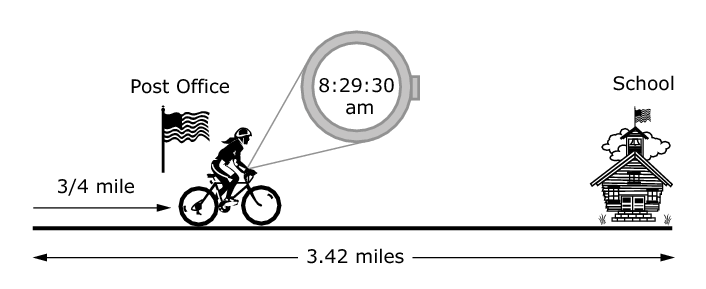
Emily leaves her house at exactly 8:25 a.m. to bike to her school, which is 3.42 miles away. When she passes the post office, which is \frac{3}{4} mile away from her home, she looks at her watch and sees that it is 30 seconds past 8:29 a.m.
-
-
If Emily’s school starts at 8:50 a.m., can Emily make it to school on time without increasing her rate of speed? Show and/or explain the work necessary to support your answer.
-
Emily can travel \frac{3}{4} mile in under 5 minutes, so she can travel 3 miles (4x as far) in under 20 minutes (4x as long.) This means that Emily will have traveled 3 miles before 8:45 (20 minutes after she left). Then there is only .42 miles left to go, and since .42 miles is less than \frac{3}{4} mile, we know she can cover that distance in less than 5 minutes. That means she will get to school before 8:50, so she will be on time.
-
-
2
-
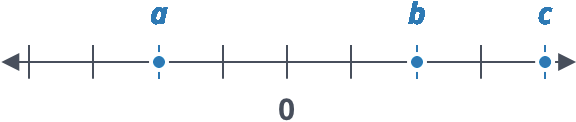
Values for variables a, b, and c are graphed on the number line shown.
-
-
Use the graph to evaluate the expressions in the table. Select one column for each row in the table to indicate whether the expression is less than 0, equal to 0, or greater than 0.
-
Expression
< 0
= 0
> 0
a – b
a + b
b – c
c – a
a + c
-
Expression
< 0
= 0
> 0
a – b
X
a + b
X
b – c
X
c – a
X
a + c
X
-
-
3
-
Maria claims that any fraction located between \frac{1}{5} and \frac{1}{7} on a number line must have a denominator of 6.
Enter a fraction that shows Maria’s claim is incorrect.
-
\frac{6}{35}, \frac{13}{70}, or any fraction between \frac{1}{7} and \frac{1}{5}
-
-
4
-
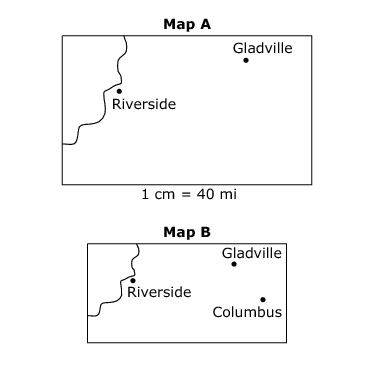
These two maps show the same area at two different scales.
- Columbus is not on Map A.
- Map B does not have a scale written on it.
- Riverside and Gladville are 6.8 cm apart on Map A.
- Riverside and Gladville are 3.4 cm apart on Map B.
- Gladville and Columbus are 1.8 cm apart on Map B.
-
-
Determine the straight line distance, in miles, from Gladville to Columbus.
-
144
-
-
5
-
Lenny bought a motorcycle. He paid 12.5% in tax. The tax added $1437.50 to the price of the motorcycle.
What was the price of the motorcycle, not including the tax?
-
11,500
-
-
6
-
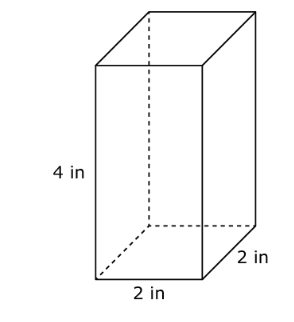
A company makes two sizes of boxes shaped like rectangular prisms. The large box is 16 inches tall, 10 inches wide, and 10 inches long. The drawing shows the dimensions of the small box.
-
-
Part A
What is the maximum number of small boxes that can fit inside the large box?
-
Part B
The company plans to increase the width and length of the large box by 4 inches each to create a new larger box. How many more of the small boxes will be able to fit inside this new larger box compared to the original large box?
-
Part A: 100
Part B: 96
-