



Grado 8
Ciencias: Ciencias naturales

Los estudiantes se enfocan en estructuras y procesos de cosas vivientes, ecosistemas, herencia y evolución biológica. También pueden explicar fenómenos del mundo real comprometiéndose en la ciencia, prácticas de ingeniería y aplicando conceptos transversales.


Preguntas de las pruebas de muestra
En esta sección encontrarás ejemplos de preguntas de examen que muestran las habilidades y los conceptos que deberían conocer y comprender los estudiantes.
-
 1
-
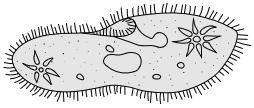
A paramecium is a single-celled freshwater organism that can be observed using a microscope. A typical paramecium is shown.
-
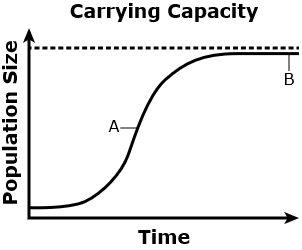
A scientist started a paramecium culture in the laboratory to study population growth. A model of population growth for the paramecium culture is shown in the graph. The carrying capacity is the number of individuals that the environment has enough resources to support.
-
Explain why the paramecium population growth is rapid at the part labeled A and why the population growth rate is slower at the part labeled B, where the population is at carrying capacity. Enter your answer in the box provided.
-
2 point
Sample Response:
At point A, the paramecium population is growing rapidly because there are unlimited resources (or more than enough resources). At point B, the growth rate slows down because there are more individuals in the same area who need resources, or resources are limited.1 point
Sample Response:
At point A, the paramecium population is growing rapidly because there are unlimited resources (or more than enough resources). ORAt point B, the growth rate slows down because there are more individuals who need the resources, or resources are limited.
0 point
Sample Response:
The population doesn’t change size. OR Resources are not needed.
-
-
2
-
A species of small fish lives in a shady pond with a dark bottom. Some of these small fish are light colored, and some are dark colored. A new predator is added to the pond, and one of its primary food sources is the small fish. The table shows the percent of each color of fish in this population before and after the predator was added.
-
Color of Fish Before New Predator After New Predator Light 51% 29% Dark 49% 71% -
Based on the data in the table, select the best phrase from the menus to complete each sentence.
-
After the new predator is added to the pond, the (select answer) have a better chance of surviving than the fish of the other color. This is because the predator (select answer) .
-
After the new predator is added to the pond, the dark-colored fish have a better chance of surviving than the fish of the other color. This is because the predator cannot see them as well as fish of the other color.
-
-
3
-
A biologist wanted to study how certain plant structures, such as colored flowers, might affect how often the plants are pollinated during the day. For one hour, on a sunny summer day, the biologist observed bee, butterfly, hummingbird, and beetle pollinators of a population of plants with equal numbers of purple, white, and pink flowers. Based on the data collected and shown in the table, the biologist made the claim that plants with purple flowers in this population attract more pollinators than do plants with flowers of other colors.
-
Flower Color and Pollinators
Flower Color Purple White Pink Bees 12 1 0 Butterflies 0 1 1 Hummingbirds 5 0 0 Beetles 0 1 1 Total Visits 17 3 2 -
Which evidence could be used to challenge the biologist’s claim that purple flowers in the population of plants attract more pollinators than other flower colors do?
-
-
A
The purple flowers did not have any butterfly or beetle pollinators.
-
B
Bees pollinated the purple flowers 12 times and the white flowers only 1 time.
-
C
Hummingbirds pollinated the purple flowers 5 times and did not pollinate the white or pink flowers.
-
D
The purple flowers were pollinated 17 times, the white flowers were pollinated 3 times, and the pink flowers were pollinated 2 times.
-
A
-
-
A
The purple flowers did not have any butterfly or beetle pollinators.
-
A
-