



Grado 5
Ciencias: Ciencias naturales

Los estudiantes se enfocan en estructuras y procesos de cosas vivientes, ecosistemas, herencia y evolución biológica. También pueden explicar fenómenos del mundo real comprometiéndose en la ciencia, prácticas de ingeniería y aplicando conceptos transversales.


Preguntas de las pruebas de muestra
En esta sección encontrarás ejemplos de preguntas de examen que muestran las habilidades y los conceptos que deberían conocer y comprender los estudiantes.
-
 1
-
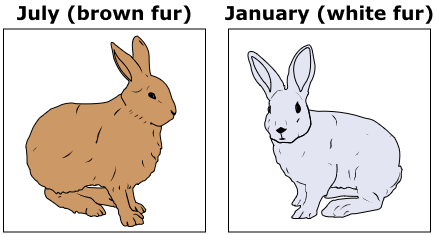
Arctic hares live in the northernmost parts of North America where the ground is covered in snow during the coldest months. Arctic hares change fur color by molting and growing new fur twice a year. The diagram shows a hare in July and a hare in January.
-
Explain how the change from a brown fur coat to a white fur coat helps arctic hares to survive in the winter.
Enter your answer in the box provided.
-
2 point
Sample Response:
White fur is good camouflage in the snow, so the arctic hare can hide more easily from predators.
1 point
Sample Response:
The white fur helps arctic hares hide in the snow. OR The white fur helps prevent the arctic hare from being eaten.
0 point
Sample Response:
The white fur helps the hare to stay warm. OR The white fur helps the arctic hares survive in the winter.
-
-
2
-
A student observed that a cactus has long, sharp spines that are painful to touch.
Which claim is best supported by the observation?
-
-
A
The spines attract helpful insects to the cactus.
-
B
The spines keep cold wind away from the cactus.
-
C
The spines make it hard for animals to eat the cactus.
-
D
The spines store water that can be used by the cactus.
-
A
-
-
C
The spines make it hard for animals to eat the cactus.
-
C
-
-
3
-
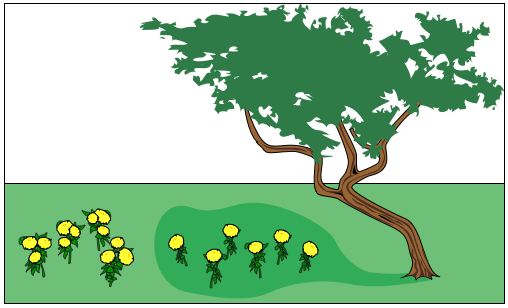
The marigold plants shown in this field all have the same parent. Some of the plants are growing in the sun, and some are growing in the shade under a tree. The plants in the sunny area have more flowers than the plants in the shade.
-
Select the statements that best complete these explanations.
The difference between the two groups of marigolds shows that the number of flowers a marigold produces (select answer) .
A marigold only produces one flower if it (select answer) .
-
The difference between the two groups of marigolds shows that the number of flowers a marigold produces changes with the environment.
A marigold only produces one flower if it does not receive enough light energy.
-