



Grado 8
Ciencias: Ciencias de la Tierra y el espacio

Los estudiantes se enfocan en el lugar de la Tierra en el universo, sistemas de la Tierra y la activad de la Tierra y los humanos. También pueden explicar fenómenos del mundo real involucrándose en la ciencia, prácticas de ingeniería y aplicando conceptos transversales.

Preguntas de las pruebas de muestra
En esta sección encontrarás ejemplos de preguntas de examen que muestran las habilidades y los conceptos que deberían conocer y comprender los estudiantes.
-
 1
-
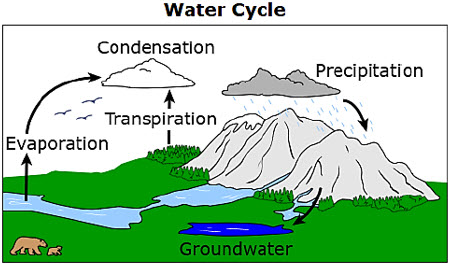
A student creates the model shown of the water cycle for a class presentation. The student’s main goal is to help the class understand how living organisms assist in the movement of water through the system.
-
-
Based on the model, what should the student say about the role of living organisms in the water cycle?
-
-
A
Plants help move water from the soil to the atmosphere.
-
B
Animals generate heat that helps evaporate water from the land.
-
C
Plant movements create wind that helps draw water into the atmosphere.
-
D
Animals create pathways in the mountains that allow water to flow downhill.
-
A
-
-
A
Plants help move water from the soil to the atmosphere.
-
A
-
-
2
-
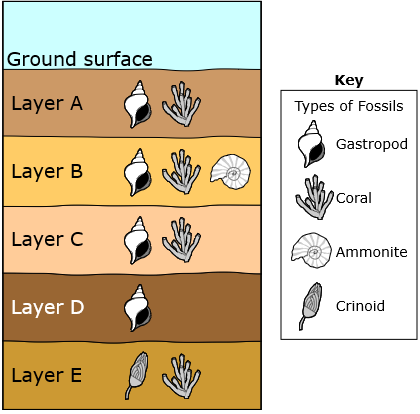
The diagram shows a cross section of layers of sedimentary rocks. The types of fossils in each layer are shown.
-
Based on the information in the cross section, select the three statements that are most likely correct.
-
-
-
3
-
A tsunami is a series of waves, and it is usually caused by an earthquake. A tsunami can only be predicted after an earthquake has already occurred. Most tsunamis are caused by earthquakes with magnitudes over 7.0 that occur under the ocean or near coastlines. These earthquakes are also less than 100 kilometers (km) below Earth’s surface. This table summarizes the magnitude, location, and depth of four earthquakes.
-
Earthquake Magnitude Location Depth (below Earth’s surface) A 3.6 Coastline 52 km B 8.9 Ocean 28 km C 7.2 Ocean 180 km D 8.5 Mid-continental 85 km -
Based on this information, which earthquake has the greatest likelihood of causing a tsunami to develop?
-
-
A
Earthquake A
-
B
Earthquake B
-
C
Earthquake C
-
D
Earthquake D
-
A
-
-
B
Earthquake B
-
B
-